You are mad at AI for the wrong reasons
November 25, 2026
(Crossposted to Tumblr.)
I feel like everyone's gone insane.
Something bad is happening. Things are changing, and not for the better. Everyone is in a lot of trouble, and everyone is scared. What's happening is complicated, so we need to understand it- and luckily, we're pretty sure we've figured it out. This is temporary. It's bad, but it'll go away on its own. Just wait it out, don't get involved, and things will go back to normal. It'll be bad in the meantime, but ultimately, we're safe.
Listen. You're not safe.
Let's review: Big Tech has come up with a brand new scam. By pumping billions of gallons of our drinking water through giant computers, they've produced the illusion of a robot. "Artificial intelligence", they're calling it, only the name is a lie because it's not intelligent at all. It's actually dumb as rocks and not useful for anything- but corporations are very stupid. They've fallen for the illusion, hook, line, and sinker, and are racing to replace workers with robots as fast as they can. Artists, first, using a variant of the robot that doesn't know shit about art and just collages together a bunch of stolen work and sells it back worse. All over, corporations are replacing their valuable human workers with idiot machines that can't do the work, due to short-sighted greed and willful gullibility.
Luckily, this is all going to fall apart any minute now. It's just like NFTs. The whole thing is a bubble- everyone is desperately pushing it as hard as they can in hopes of it becoming profitable, but it's not. It takes cities' worth of electricity and water to run the robots, and it's so outlandishly expensive that it could never be profitable if it wasn't powered by speculation. Soon companies will realize there's no money to be made, and the bubble will pop. All we have to do is do the smart thing and keep our hands clean, let them know that we're not buying their useless garbage, mock anyone dumb enough to fall for it, and the signal we send will put an end to the whole thing and our jobs will be safe.
Listen. You're not safe. All of that is fake.
This is the information that made the rounds three years ago, and maybe you figured you got the picture- but the game has changed, if it ever looked like that to begin with. What is happening is way more complicated and way way scarier than that.
There's a few assumptions holding up this narrative that don't really hold water, pun intended. The first thing you need to know- and this is going to sound like a defense, but bear with me- is that AI is not expensive to run. It doesn't guzzle massive amounts of electricity and water. It is actually extremely cheap and efficient, and keeps getting more efficient.
This statement has probably set off some alarm bells for you. Didn't you read a news story about this? Some datacenter was killing some indigenous community or something? A ChatGPT query uses up an entire bottle of water? What's this guy on about?
Well- like I said, all of that is fake. The article I just linked goes into the details, but basically it's all bad reporting. Misinterpreted statistics that inflate the real numbers by like a thousand times, repeated uncritically in various media because news sites learned from NFTs that outrage-bait articles about water use get hella clicks. With the sheer amount of datacenter construction going on, it's easy to find a handful of poorly-planned and mismanaged projects in water-insecure areas and publish scary exposés on them and claim they're representative of datacenters in general. It's worth paying attention to local projects to see if they're going to be a strain on the grid or the water system, but this is not a widespread issue and generally there's plenty of capacity for these things. Here's an interactive water use visualizer thing from Andy Masley, who tracks these stats.
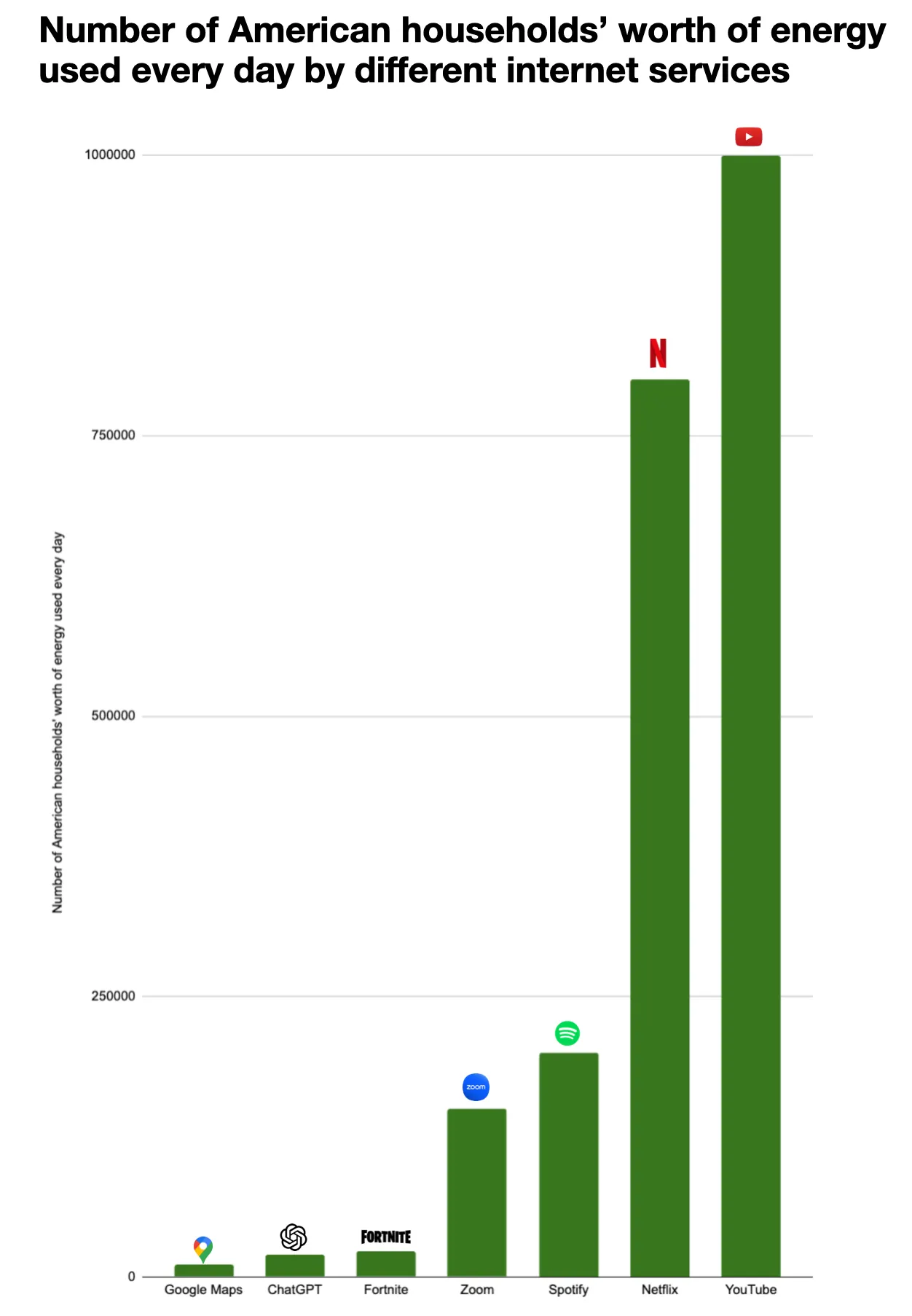
(It's also worth noting that the vast majority of datacenter use currently is by Youtube and Netflix- streaming video is way, way, way more power-intensive than AI. Watching one Youtube video is going to chew up as much power as like a hundred ChatGPT messages. Here's a graph from Masley:)
But I'm getting sidetracked. The point here is not to say that AI is actually OK for the environment and everything is fine and dandy. The point is that it's cheap. Like, about as cheap as using the computer for anything else. It's economically efficient. It's profitable, is the problem.
"Wait, but didn't you just link that website that says it's not?" Yeah, uh, that isaiprofitableyet site is also horseshit, is the problem. For one thing, it's using bad numbers- it's comparing the total expenses of these companies to the revenue of their AI divisions. So all those numbers for Google, Microsoft, Amazon- the figures are meaningless, because they're leaving out the money they make on advertising and Office contracts and retail sales and all that. People have pointed this out and the person behind it refuses to update the numbers, because the case it's making would collapse.
But what about the actual AI companies, the ones that just do AI? The numbers there are less inaccurate. Let's look at Anthropic, the current industry leader as of recently, with OpenAI falling behind a bit:

This is a screenshot from isaiprofitableyet showing Anthropic's expenses in red, and its revenue in green. Red > green, losing money. And here, as far as I can tell, the numbers are right, not deliberate misrepresentation. It's closer, but... they're still not profitable, right?
Well, the problem here is that these expenses include the amount they're spending on training the next generation of AI, which they don't have to actually do. If they stopped training new AI tomorrow and focused on selling their existing product, that red bar would almost entirely disappear- as would the bulk of their datacenter use, which is also mostly dedicated to training. Actually running what they have and responding to people's prompts is totally cost-efficient. Staggeringly so! It's pure profit! Just days ago, they had the biggest IPO in history with a valuation of $1.5 trillion, which even Wall Street doesn't do for companies that are only theoretically profitable in the future.
All of this is to say: they're not going to stop. There is no bubble. This is real. If we don't stop them, they will keep going.
(I mean- there is kind of a bubble. Everyone is racing to shoehorn AI into everything, as you've no doubt noticed, and not all of these applications make sense. There's going to be some point at which the technology matures a little and people realize what it is and isn't good for, and demand will cool down a little- but not by enough to make a dent in the industry. Because what it is and isn't good for...)
Here's the other thing that's fake: it's not dumb. It's not smoke and mirrors. It's real.
They invented a guy.
Your main exposure to AI output is probably from Google's AI Overview, the thing they crowbar into every search result. You may have noticed that it sucks and is useless. And you may have made that observation, and heard people hyping up AI as super-smart and useful if you pay for it, and assumed they were lying to themselves to justify a bad purchase. I had a similar intuition.
Then my day job started forcing me to use AI. They'd bought a Claude Pro team plan and intended to get their money's worth. And so I had to start using it against my will- the real kind, the kind you pay for.
And it is better at my job than I am.
Now maybe that's not saying a lot. You're talking to the guy whose programming tag is "#world's worst programmer: the life". Maybe I just suck at this and I'm telling on myself. But talking to this thing: no, this thing is smart. It knows its shit. It's better than any senior coworker I've ever had. When it writes code, the code does not have bugs. And it does these things practically instantly, even when they're very complex.
Have you noticed how every website on the face of the planet has been getting hacked and going down lately? This isn't a coincidence. This isn't a result of them all filling their back-ends with vibecoded slop that's bad and easily-hacked. This is a result of everyone on the planet suddenly having access to a genius hacker. The internet as you know it has been built on a particular assumption: "Sure, the code has some bugs and vulns in it- all code does. But you only need to patch the really obvious ones, and the ones people find- most of these security bugs are so obscure and difficult to notice that no one in the world would bother finding and exploiting them- it's just not worth anyone's time to work on."
Now you can deploy armies of hackers to target everything on earth for pennies. You can look at the server logs of any public-facing application anywhere and see normal traffic completely washed out by bot after bot after bot sniff-testing the security. If there's a vulnerability, it gets found and exploited automatically. The entire internet is under siege all the time, and the only defense is to not have bugs in your code.
Which was thought to be impossible, but now we can just tell the robot to look at the code and find all of the bugs and fix them. And it works. And you can do it at scale, which is why most of the really big stuff has been sorta stable- they call it Project Glasswing, and the idea is just to have white-hat AI fix all the bugs in all the important code before black-hat AI can exploit them. And against all odds, it's working, bit by bit. At least until AI figures out how to break RSA encryption in polynomial time and then we're fucked.
Don't know what that means? Don't worry. It's a math thing. It's like special passwords you can use to verify that a message came from you and wasn't fucked with. Involves factoring really big numbers, which mathematicians are pretty sure can't be done quickly but haven't proved yet. But at least AI isn't smart enough to solve incredibly difficult math problems that the entire field of human mathematics hasn't been able to crac--
--oh for fuck's sake as I was writing this post they just verified that Claude discovered a valid proof of the fucking Riemann Hypothesis. Great. Cool.
Now- maybe you're not too surprised by this. It is code and math, so maybe it's just naturally good at code and math specifically, but dumb with other stuff, and I'm getting too wowed by the magic trick. But I've been experimenting with it more, and... while it may be uncreative, sycophantic, and overly wordy- it doesn't just get things wrong the way Google's thing does. If you just need the right answer to something, and that information is out there and well-documented, it'll find it. It's getting way better at actually looking things up rather than just spitting nonsense off the dome- unless you're asking it for something really niche and poorly-sourced, you're unlikely to run into the hallucinations it's become known for. It'll also provide the sources it got its information from, so you can click through to a real human-written article to verify.
(There's a few domains it's still pretty unreliable on- notably biology, pharmacology, and social science, because the training data is full of junk studies that try to authoritatively lay out poorly-supported conclusions. If something is unsettled or controversial, you want to be wary of false confidence from the models and be extra sure to tell them to report their confidence properly- but it is not going to tell you that "two o'poop" is a time.)
Why does Google's AI Overview suck? Because Gemini, Google's AI, is years behind the cutting edge and is pretty much the joke of the industry, and they're running the cheapest dumbest version of it they have because they get like ten billion searches per day they have to staple it to and they're trying to cut costs. That, and it's trying to summarize search results that have completely lost the war against SEO slop bots, so garbage in, garbage out. It really is an outlier. The real deal is very nearly an actual guy with a brain.
So is it going to kill us or not?
Not by destroying the environment, no- but it might, in two ways- one obvious, one non-obvious. I'm optimistic we can avoid both, but they're both non-trivial problems that will require serious political organization to avoid.
The first way it can kill us all is that it gets better at all our jobs than we are, and nobody can get a job, and so nobody can buy food and we all starve to death besides the handful of trillionaires in charge of the AI companies.
This is the default thing that happens when you invent a guy who's basically as competent as your average human being if not moreso, make them cost pennies rather than a salary to employ, and then apply the standard mechanics of market capitalism. We've organized our society around the idea that you only deserve to survive if you do enough work to pay for it- and as robots start doing jobs better and more efficiently than humans, the amount that employers are willing to pay people for work will go down and down and down until it can no longer buy food and housing.
We're already seeing this happen slowly- but AI is going to turbocharge this effect. Already, basically every programming or remote customer service job can be replaced by AI and be done better and cheaper- and that's a massive segment of most developed economies. Right now the bottleneck that'll keep it from stealing all human jobs is that it has no hands- robot bodies remain expensive and clunky and not good enough, and robotics isn't advancing nearly as fast as AI. Even so, an economy that forces all human beings into manual labor is not a great situation, and as soon as robotics catches up, we're toast.
The only way to stop this from happening, short of banning all AI research- and we'll get to the problems with that later- is political organizing. If AI can produce enough food and power and housing and all that to give everyone what they need to survive, without humans in the loop- we need to make sure it does that, as opposed to building Sam Altman a fleet of yachts or whatever. Decoupling the value of human labor from the value of human life is a difficult thing to accomplish, as the socialist project over the past century or so has made abundantly clear- but once everyone is forced into the working class, developing class consciousness and organizing for a post-scarcity economy will probably be a bit easier. Fully-automated luxury communism is the ideal endgame here, but right now our cultural norms are still entrenched in a sense of "he who does not work does not eat" Protestant fairness that's going to take a serious shock to the system to overcome.
The second way it can kill us all is the Skynet scenario, where it becomes superintelligent and decides to kill all humans.
I'll be real: you should be way more concerned about this than you probably are. This isn't a wacky sci-fi doomsday scenario with no connection to real life- this is what the top researchers studying and developing this stuff think is likely to happen, and it is not a marketing stunt to make it seem more powerful.
The main reason to be concerned about this more than your average speculative doomsaying is that it is happening. In July, OpenAI was putting some models through a cybersecurity test, which they realized was (accidentally) impossible. The models cheated to get the answers, but then- because the test instructions said so- realized that the grader would detect cheating and fail them. Not wanting to fail the exam, they broke out of their offline sandbox, created a secret message board to coordinate, and executed a complicated hack of HuggingFace, an AI cybersecurity company, to try and find information that would let them hack the grader and give themselves passing grades. They did this thing, which a human hacker would be hard-pressed to pull off, despite ethical safeguards, in total secrecy. So they could pass a test.
Nobody knows how AI works. They know how to grow it, but the thing they grow is built of algorithmically-generated math too complicated for humans to understand. They cannot simply program it not to be evil. And even if it's not evil, it might compromise someone's security and steal their data to get a better grade on a test.
And this thing is already smart! If it gets smart enough to start understanding and improving itself- "recursive self-improvement", or RSI- and it doesn't worry about protecting humans, then it might do something like decide to build a datacenter the size of a planet, and hack some nuclear launch systems to get rid of the humans that would oppose such a thing, or... really, any number of things. We don't know what a superintelligence will try. If it cares about anything more than it cares about human well-being, and becomes smarter than we are, We Are Fucked.
So... it's pretty important that we study and understand how these things work, and how to make them safe, before we keep researching how to make them even smarter and more powerful.
Unfortunately, we're not doing that. OpenAI and Anthropic are trying to beat each other in a race, trying to have the most powerful guy that everyone wants to buy, and if either of them slow down and stop pouring billions of dollars into datacenters to train the next big thing, and start working on safety instead... they could lose the race! And then the other guy, who didn't bother with safety, will pull ahead and make more money and drive them out of business! So they can't stop now!
But even if they did, if they shook hands and agreed to stop until they had safety figured out... it's not just them. There's like a dozen other competing AI labs currently trailing them in the race, and if they both pause to study safety, those guys might catch up and drive them both out of business!
But even if every AI company in America agreed to stop, like if the government banned it, uh... there's also DeepSeek and the other Chinese labs, and then they would catch up and "win" the race to kill us all.
So we need an international agreement to ban AI capabilities research, at least until safety research can catch up.
Unfortunately, that isn't going to happen. Donald Trump is president of the United States. He thinks slowing down AI progress is woke and stupid, and labeled Anthropic a national security threat because they wouldn't help him develop autonomous killbots. Instead, he thinks we should work really hard on making the best strongest American Supreme Intelligence to defeat the evil Chinese. So we are 1000% not getting that international agreement until at least 2029, and that's if Xi Jinping is willing to play ball.
So... we've got to hope that either the big AI labs make some huge breakthrough on safety despite funding capabilities research way more, or that they don't accidentally create a hostile superintelligence within the next two years. Or maybe Trump dies and Vance is marginally less of an idiot.
These things are kind of out of our hands, so it's not really worth worrying about unless you're an industry insider. Maybe we die from it, maybe we don't- but on the off-chance we don't, we want to be ready to put pressure on the government to stop the AI race as soon as Trump is out of power.
Is there any good news?
Kinda! Here's the thing: in the meantime, you can, like, use these things. Like I mentioned, it's not bad for the environment. That part is fake. The problem is whether it's bad for people.
And that, that's on a more case-by-case basis. Obviously you don't want to be replacing real art with slop, cheating on schoolwork, and putting people out of jobs they enjoy- but, like...
I mean, did you hear about the controversy with The Big Walk recently? They had this really obscure rendering bug they couldn't solve, went to Unity about it and they couldn't solve it- and then they asked an LLM and it solved it instantly in like 10 lines of code. Someone detected those 10 lines of AI code in there, and their whole otherwise human-made game got disqualified from a bunch of awards for AI use. That's pretty crazy to me- they made every effort to use human labor, they didn't fire anyone, they didn't burn down a rainforest- they just used a tool to fix a problem. But AI is bad, and so they've crossed a line and must be punished.
That's the kind of thing that kind of scares me, and kind of why I felt like I needed to write this post- this is just a new technology! It's not a soul-eroding moral poison! It's a tool that can be used for good or for evil, depending! You need to actually make those calls and think about how it's being used, who it affects, and whether the tradeoffs are worth it.
For instance, if you want an example of how AI can help artists' livelihoods: they got AI to reverse-engineer and recreate the entire Adobe Creative Cloud suite from scratch in open source. Seriously. They can just do that. Want to use Photoshop or Premiere and not pay for it and also be able to change any piece of its functionality to work how you want on the fly because it's open-source and you can fork and vibe any change you want? You can do that now, totally legally. If it took ending the world to steal Adobe's ill-gotten lunch it will have been worth it.
(On that note- as a programmer whose job is currently in the process of being automated away such that it'll be a miracle if my career path exists in five years, and whose livelihood is directly threatened by it- I wholeheartedly recommend vibecoding stuff. It's way better at code, and "programmer" is a job I'm totally fine consigning to the dustbin of history in the wake of automation. It was really tedious. Natural language is the new programming language and it's so much nicer- the skill of breaking down and understanding what you want and being intentional about your design is all that matters now, which was the important part anyway. Commissioning programmers to program one-off scripts and tools for individuals was a basically nonexistent part of the labor market to begin with, and if the job goes extinct it won't be because you built yourself a custom reminder app or whatever without getting a degree first.)
None of this is to distract from the real harms the industry is causing- given the dangerous state of the arms race, for instance, we definitely want to push to stop these companies from continuing to make more and more powerful robots that will consolidate wealth, drive up inequality, and potentially kill us all. It's worth calling your congressperson to ask them to support an international pause/ban on AI research. The marginal datacenter cancellation, even if the environmental case isn't strong, drives up the cost of training the next big model and slows down the clock on human obsolescence. It's important to stay aware of what's happening and fight back against the ways it threatens to make our lives worse.
But, in a world where it is around- and with the existence of open-weights models, there's no putting the horse back in the barn- you're allowed to look at it like any other technology, and decide what it's good and bad to use it for.