You Can See Everything/Every Single 3D-Animated Barbie Movie: a double review
November 19, 2026
The following review contains spoilers for You Can See Everything and every single 3D-animated Barbie movie. You Can See Everything is really good and I recommend watching it before reading this review, though I'm really only spoiling the first third of it. I would not recommend watching every single Barbie movie before reading this review. I would really, really not recommend that.
I've fallen in with the wrong crowd. A dangerous collection of perverts, narcoleptics, dyslexics, gamers, thespians, pirates, Frenchmen, and youtubers- who together conspire to inflict terrible and senseless suffering on one another. Among the many indignities I've been subject to is a months-long series of marathon movie nights, in which we watched every single 3D-animated Barbie movie.
More recently, I went to see an actual movie: Nathan Fielder's You Can See Everything, a documentary about... broadly, the life of Elizabeth Holmes after being disgraced in the wake of her fraud conviction and the collapse of Theranos.
And- because the poison was in my brain, you see- I realized. It all made sense. There's a way to understand what happened in You Can See Everything- because it's her. Elizabeth Holmes... is Barbie.
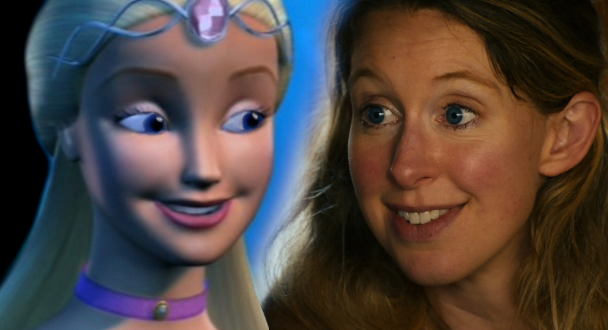
For that to mean anything, you need to know: who is Barbie?
And you could be forgiven for not really knowing the answer to that question. I, personally, had no idea for a very long time, because I was raised male in a world where knowing things about Barbie made you a cooties vector. But even if you're not averting your eyes, the messaging is mixed at best. Per The Economist, Barbie is an...
She's also a fairy, a princess, a mermaid, a fairy princess, a mermaid fairy, a princess mermaid, a pop star, a superhero, and on at least one occasion, a swan. Mattel would like you to believe that Barbie is everything.
You can see that, right?
And yet despite all her many professions, it's very clear that there is a character that Barbie is supposed to be. She's defined subtractively, by the many things she is not. She is never mean, she is never impatient, she never lies, she never loses heart, she is never fat, she is never old, she is never gay. Most of all, it is never her fault.
Barbie is not allowed to have substantial flaws. While she occasionally manages to exhibit flaws in these films, the films never seem aware that she has them. But because stories need antagonists, and so need to have people who dislike Barbie in some way, Barbie must bear a multitude of nebulous and ephemeral sins. Most commonly she is clumsy- not like, in a way that's a consistent character trait or obstacle for the duration of the film, no, she has to be a ballet prodigy at the drop of a hat- but just long enough for her to accidentally bump into some manner of cackling witch played by Kathleen Barr. And while an interaction like that on the subway wouldn't merit more than an "excuse me" if that from you and me, in the eyes of Kathleen Barr it is a mortal sin that demands she ruin Barbie's entire life.
Villains in Barbie movies are, when remotely human, motivated primarily by jealousy. Barbie is perfect, and has a perfect life and perfectly loyal friends and at least one perfectly horrifying-looking talking animal companion, and Kathleen Barr hates her for this. You can't risk the audience taking their side and not liking Barbie. When there is insufficient narrative cohesion to even put Barbie in a personal conflict with a villain, they are instead driven by some cartoonish obsession like making puppies illegal, stealing all music, or turning the ocean into goo. No one is allowed to do anything bad to Barbie for a good reason.
At the end of every Barbie movie, they put an inspirational quote onscreen, usually attributed to Barbie and usually (but not always) actually a quote from the movie you just watched. The moral of the story, you see. And because Barbie is never allowed to have a flaw or learn a lesson, the moral of the story is always something that the Karen at the customer service desk could use as a rallying cry. "Listen to the beat of your heart!" or "you're braver than you know!" or "you're perfect just the way you are!" or "live your dream!" or "the most beautiful thing you can be is yourself!" ("Yourself" is a word which here means "blonde and rich and conventionally attractive".) You are great, and so your misfortunes must be some kind of unknowable accident that has happened to you that will eventually go away. Kathleen Barr is not real.
You Can See Everything is an impossible movie. Nobody on Earth could make this movie ever again even if they tried. It is, frankly, insane that it exists. And it could not exist if Elizabeth Holmes was not the person she is.
(Barbie.)
Elizabeth Holmes, having no idea who Nathan Fielder was beyond "a famous documentary guy", utterly failing to get the joke of everything he's ever made, invited him into her home to record everything she and her family said and did for a month, on the basis that this would reveal the real truth of who she was- thereby countering the unkind and bogus narratives being spun about her by the press.
I'm skipping over the details of everything that went down with Theranos, because the movie does too. The basics, if you need them: Holmes claimed to have invented a blood-testing machine that was much stronger and more versatile than anything else on the market, got several billion dollars of investor funding and tons of buzz, and then... it turned out that the machine didn't work at all and never even came close to working at all and existed almost entirely as a fiction. They call this "fraud" and she got convicted of it in the most open-and-shut fraud case you've ever seen.
You Can See Everything takes place at Holmes' beachside house in the month between her sentencing and imprisonment, and largely concerns Nathan Fielder's attempts to get the story out of her. Why did she lie to everyone for so long? If she didn't lie, why did everyone start believing that she did? How did things get this bad?
Holmes smiles, and asks "What do you mean?"
Holmes, it turns out, has never lied once, a single time in her life, ever. She would never lie! She is not a liar. What do you mean?
Oh, okay, Fielder asks- so the Edison works? Yes, she answers. It always worked. It works great! Look, here it is, on the table, the device, working! Not right now, obviously, because it's turned off, and it's not receiving any instructions from The Cloud, but if it were, it would be working! So it is working, because here is how it works: The Cloud. It's her brilliant genius idea and it works.
Oh, okay, Fielder says, skeptically. So why do people think it doesn't work? How come they convicted you of lying in court?
She smiles and asks "What do you mean?"
Elizabeth Holmes is Barbie. She is never mean, she is never impatient, she never lies, she never loses heart, she is never fat, she is never old, she is never gay. Most of all, it is never her fault. She does not have flaws, and when bad things happen to her they are unknowable accidents that will eventually go away as long as you listen to the beat of your heart.
In Barbie and the Secret Door, the second-worst Barbie movie, Barbie is the princess of the kingdom of Unspecified, and- fed up with all her impossible soul-crushing responsibilities, such as going to one party or doing a single thing she doesn't feel like doing ever- finds a magical door to a fantasy fairyland. Barbie is very great and very nice, but when a spoiled evil princess who wants to steal everyone's magic shows up, she is powerless to stop her, because she doesn't have enough confidence in herself. At the end of the movie, for zero reason at all, Barbie gains self-confidence and goes to stop the evil princess, by... uh, just sort of standing there and being very great and very nice. The evil princess flies into a rage, attempts to steal her magic goodness power, and accidentally absorbs too much and explodes, without Barbie having to do a single thing besides radiantly Be Herself.
This is how Elizabeth Holmes thinks she can solve her problems. She doesn't need to think about how there's a Kathleen Barr trying to ruin her life. That's there, sort of, and if you really really press her you might get her to acknowledge that she's in trouble for two or three seconds at a time- but she doesn't need to think about that. You can ignore any conflict as long as you have enough self-confidence, which will in the end magically get rid of any problems without having to allow the problems into your mental landscape.
It's incredibly scary, really. I really believe her when she says she wasn't in it for the money. Holmes is just barely cognizant of the fact that anything bad has happened to her, ever. She refuses to let it get to her! She is living her truth! And her truth is that when she had a brilliant idea for an invention, the invention worked. Everyone did a great job, and it worked on the first try, and it was going to change the world and save lives. Saying "The Cloud" was enough to summon motive power into the device, via her good invention idea. Presumably at some point someone in the company told her "hey, this doesn't work yet, maybe we shouldn't tell the investors that it works", but she didn't hear that. She couldn't. That would be a bad thing.
Bad things do not happen to Elizabeth Holmes, much less ones that are her fault. She is happy! That's the truth, is that she's happy and doing great. Her lies aren't even aimed at anyone else- they're just ambiently produced as she lives her dream. Here she is, Barbie in her California beach house with her perfect boyfriend that she's technically not married to who loves her so so much. She is wise and truthful and brave and a genius and all the little girls should want to be like her. She's walled herself into the Dream House, separated from reality entirely.
Is this Mattel's doing?
Barbie is synonymous with American femininity, and I don't know to what extent she reflects it and to what extent she defines it. Greta Gerwig's 2023 Barbie attempts to interrogate this question early on, but ultimately ends up failing to take a stance on it as the movie shifts into Ken Mode for the latter half. Does Barbie embody the mainstream conception of womanhood because the marketing team at Mattel made absolutely sure that no depiction of Barbie stepped a toe out of line, or was the mainstream conception of womanhood created by the marketing team telling every sssingle little girl in America what a woman was supposed to look like?
(It's a question I'm always struggling with and don't know how to empirically answer- how powerful are marketing departments? How much of our culture is intentionally shaped by people pouring money into doing exactly that, and how much of marketing is just identifying that culture and taking advantage of it?)
Regardless, it's hard not to be suspicious that something happened here. You Can See Everything gestures at some possible reasons for Holmes' retreat into fantasy- it's very plausibly a trauma response, if certain things are true. But the fantasy was there to retreat to- a world where you're perfect and never made any mistakes, where the real you is a genius polymath who lives on the beaches of California and always sounds a little bit like a waitress angling for a tip. I can't help but suspect that someone put it there.