It Is Possible To Write A Mystery Game
November 13, 2026
Earlier I talked about the challenges inherent in writing mystery novels- in short, that you have to write your story multiple times for different kinds of readers, because you can't ensure that readers will be on the same page about important details when they need to be.
Mystery games, though, have an advantage that mystery novels don't: you can check the reader's comprehension. You can say "okay, if you haven't figured out this much, you can't proceed until you get it." You see this all the time in games like Ace Attorney or Danganronpa- the question you want the reader to be asking? Put up a multiple-choice screen asking that question. Now answering that question is their problem, right now, even if they weren't considering it before. The reading comprehension test is in the story. If you fail it, you don't proceed. If you already had it worked out, you just click the right answer immediately and move on. You don't get to later parts of the game without comprehending earlier parts.
This lets you sort of smooth out the variance in reader responses. If a certain twist relies on understanding some aspect of setup that the reader might've missed, you can force everyone through a gate that ensures everyone on the other side got it. If someone falls behind where you wanted them, you give them the chance to catch back up before moving on. There's only so off-script you can get.
This approach is limited, though. The most common failure mode for this approach is wasting the attentive reader's time- having to click through and answer a bunch of reading comprehension questions for something you've already more or less comprehended slows things down. It can be a real drag when you've already figured out that the twist was possible because the knife was made of ice, and the game asks "Did you notice there was water on the ground?" "Did you remember that this takes place in winter??" "Could the murder weapon actually still be in the room???"
That said, this isn't a problem that's worse with games, necessarily. A normal mystery novel may need to spend some time highlighting these things for the reader when a faster reader is way ahead of that stuff, and need a way to keep that faster reader's attention while telling them things they already know. Hard to make your story worse with these comprehension checks...
...except when you're building up to a fakeout.
Say you've got a case where the murderer has manipulated the crime scene to make it look like the victim was dead when they were discovered, when actually they'd just been drugged and the killer did the actual murder while pretending to inspect the body. Pretty classic trick, creating an alibi that way.
So in your game, in the early stages of the investigation, you want the detective to initially be fooled by this trick. They start investigating it as a closed room, figuring out who could've got in at the (fake) time of death. You've got this whole bit where the real murderer planted a room key on some other character afterwards as a red herring, and they start searching everyone's effects to reveal this, maybe dropping some other hints in the process. This whole fakeout is load-bearing to the story of how they ultimately reach the truth.
But one of your players has seen this sort of trick before, and has noticed that it hasn't been ruled out, noticed some hints you dropped earlier that this person may have been drugged when they were last seen alive, figured out your angle. They know the red herring didn't do it, that the key must've been planted.
Up pops the screen: "The murderer could only have entered the crime scene with the key! Who was it?"
And here they're forced to say "The red herring did it!", or else they've put down the wrong answer that won't allow them to proceed!
If you're reading this as a novel, you can just laugh at the detective's temporary foolishness and sit smugly in the knowledge that you're one step ahead of them- but if you're playing the game, you have to knowingly give the wrong answer to the test- a wrong answer the game will later chastise you for. "You were tricked!" it says, but you weren't! You weren't!! You had to pretend to be an idiot just to make the game let you keep playing it, become complicit in prosecuting an innocent person for a crime they didn't commit!
Related to this failure mode is the case where the player has shortcut your reasoning. Say you're trying to set up this reveal that someone used an icicle as a knife. Your eagle-eyed player has noticed the water on the floor, and has already jumped to the true conclusion that this happened. But you've set up a whole chain of reasoning to lead the player there- that icicles had been present overhanging a door which went missing just before the nearby murder, and this really tall character couldn't have gone through that door without bumping their head on the icicles on the way in, so they must've done so after the murderer took an icicle from that spot and knocked them down, but this short character could've gone through the door at any time... yada yada yada, some kind of lateral-thinking-based alibi hunt indicating that someone's lying about how tall they are, which is supposed to lead into a deduction that they had a reason to lie about how they interacted with the icicles there, and then the deduction that they used the icicle as the murder weapon...
"Aha!" the detective says! "This contradiction means that this character must secretly be wearing stilts!"
Up pops the screen: "Which of the suspects is secretly wearing stilts?"
And here the player who noticed the melted water and realized it had to be an icicle earlier is completely lost. They weren't analyzing people's pants or their footprints to try and figure out who the secret stilter was! Why would they? They know what really happened! But the game isn't letting them continue until they solve this completely different mystery that doesn't matter! They just want to say "it was an icicle!" and move on, but they're stuck following the game's logic instead of their own!
Worse still is a similar problem borne entirely of negligence, which inexplicably plagues all the biggest and most popular mystery games: not even thinking about what the right answers are.
Say it's a perfectly standard murder setup: victim, stabbed with a knife. You have, in your little inventory of evidence, the bloody knife! And at some point in the investigation, it becomes necessary to establish what the murder weapon was, even though it's pretty obvious because you found that knife lodged in the victim's chest.
Up pops the screen: "Which of your pieces of evidence shows what the murder weapon was?"
So, to proceed, you of course present the bloody knife you found at the crime scene. And the game goes "BZZZZT, WRONG!" and slaps you with a penalty to your credibility-based HP bar thingy.
This is shocking! There was a bloody knife right there, right in the fatal wound, and you didn't find any other murder weapon! Was there a hidden weapon, somewhere? Did you jump to conclusions too quickly? What about... this swordfish steak on the table, maybe it's implying that the swordfish's blade was in the kitchen somewhere, and they used that? BZZZZT. There was a broken radio nearby- maybe they took the antenna and sharpened it? BZZZZT. There's a witness statement here that says that they saw a bird fly by- maybe the bird was delivering a gun, or it killed them with its talons? BZZZZT. There was a wine glass in the sink- maybe they were poisoned? BZZZZT.
You're almost out of credibility-health, and you've presented almost everything- in desperation, you present the crime scene photo that shows the floor, thinking maybe the killer used a splintered floorboard that they cleverly replaced under the body so the blood spill wouldn't be suspicious.
DING, the game goes. That's right! In the crime scene photo that shows the state of the body, there's a bloody knife in it! That must be the murder weapon!
...
NO, ACTUALLY, GAME, THE MURDER WEAPON IS THAT I AM STRANGLING YOU WITH MY BARE HANDS RIGHT NOW. I DON'T KNOW THAT VIDEOGAMES EVEN NEED TO BREATHE, BUT SOMEHOW I WILL MAKE IT WORK.
This particular failure mode of mystery games drives me completely insane. Structurally, there's no reason for this to be an issue. It is not prohibitively difficult to program more than one correct response to a multiple-choice question. It's entirely a failure of imagination- not reading the question as a question and considering how the player might answer it, but writing the question with the intended answer already in mind.
There's limits to this, though. Oftentimes a mystery game will have dozens of questions, and dozens of pieces of evidence that could potentially be used to answer them. All you really need to do for each question is skim over your available answers and briefly put yourself in the player's shoes, looking for standout answers. Get a playtester or two, if you can afford it, and record what they try to see what answers make a certain kind of sense that you didn't expect.
What you shouldn't do, because that would be insane, is look at every single piece of evidence with every single question in the game and actively think "why might the player try to submit this piece of evidence?"
Like, that'd be crazy. It might help you catch a few edge cases where a certain answer really ought to count, or at least give you a hint, but like... most of these situations are going to be completely loopy. No, there's no reason a player would answer "the victim's tattoos" to the question "where was Suspect X on the day before the murder". What, does the player think their alibi was that they were tattooing the victim at the time? That's stupid. That's not worth coming up with special failstate dialogue for.
Seriously. If you had like, 30 pieces of evidence, and 30 questions in the game, you'd have to write, like, 900 unique dialogue exchanges explaining why that evidence does or doesn't have any bearing on the question, and like 60% of them would be so comically inapplicable that you'd have no choice but to make them jokes and characterize your protagonist as a total lunatic with an overactive imagination.
No one sane would do that. It would be such a bad idea. It would take like a whole year just to write them all.
Which I know, because I did it.
There are advantages to doing it this way! You of course dodge that last problem completely- that was the impetus, being tired of getting slapped with penalties in Ace Attorney and Danganronpa when I was right- and it works wonders for the second problem too- if, when you're wrong, the game explains to you how you're wrong, it's much harder to get stuck. You can remove all ambiguity from the questions- if you don't know what something is really asking, trying a few wrong answers will give you a sense of what it's expecting from you.
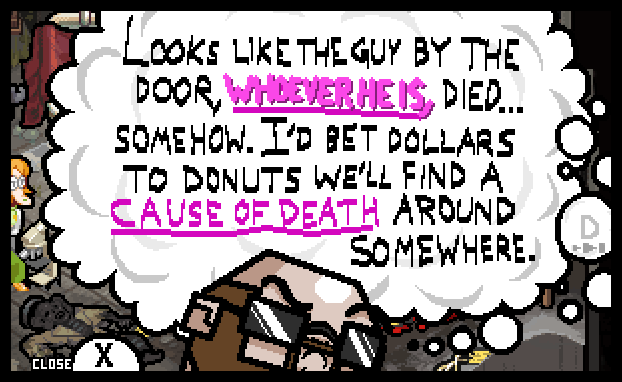
The first problem, though, forcing the player to play along with a fakeout, is a little harder to deal with. Theoretically, you can do that in a game- if the player points out the real culprit, or the real murder weapon, way ahead of when they were supposed to figure it out... you can skip ahead! A book can't say "if you've realized the murderer was actually Stabby McFacerson, turn to page 200".
...But even when you can do a subtle knowledge check like that, the writing effort required balloons even further. If there's information revealed during the process of working through the fakeout, you need to write in alternate ways to get that information to the player. You have to double and triple-check all your dialogue, to make sure you don't accidentally reference exchanges that took place during the skipped segment. You have to write in all these little flags and detours to account for pieces of the story- and sometimes vital characterization- going missing. It requires an intimate level of understanding of how your story is constructed, and that's probably why you don't really see it happen in commercial games with multi-person writing teams.
The downside of doing all this is that it is a crazy person thing to do that takes forever and- if you are good at writing a mystery- will not even come up in most players' playthroughs! Star Seeker in: the Secret of the Sorcerous Standoff has an average playtime of two and a half hours, and those players see roughly a tenth of the total writing done for the game. The tradeoffs are perhaps not 100% worth it.
So. I. Probably should not do it again for the sequel that's planned to be like six times as long. I think. I think probably that would not be the wisest decision.
Let me, uh, check whether I'm wise...
...uh-oh.