Videogames are... NOT a waste of time?
November 18, 2026
notarealwelder has some responses to my earlier post on why videogames are too long:
So- uh, firstly: pretty much all totally correct and good points, and my epistemic hygiene here was not great. My argument is in shambles. Let me see if I can pick up the pieces, here.
First- okay, yes, there is demand for very long-form content. There is an audience that wants to spend the maximum amount of time with their brains turned off, killing as many hours as they can for the smallest dollar value. It... might even be a large one. This is a factor I considered, but kind of figured it would be gauche to draw attention to? Like, oh, the post is arguing that they make long games for the audience of people who like to have lots of their time wasted, a type of person who is different from and lesser than I, the enlightened taste-haver? I don't want to just be scolding people for liking repetitive slop. That's a cold take, and...
...well, kind of unfair, because I know from experience that one's appetite for that kind of thing goes up when all your energy is getting taken up by a day job or something and you just want to unwind after work. It's not actually a moral failing, but there's something kind of embarrassing about it anyway and I didn't want to try and make the point while modulating how offensive I might be being to friends who really like losing themselves in some 500-hour behemoth whatever.
But also... I don't think that's entirely it? The audience for huge double-digit season TV shows and multimillion word web serials isn't that big. It's kind of niche. I do think that in most forms of media, being really really long is actively unappealing to consumers. For instance, Marvel saw a huge fall-off in its box office numbers after having their big finale with Endgame, and then saying "okay, now we're going to have a dozen TV shows we'll expect you to be caught up on before the next one". And the massive backlog of continuity in superhero comics is like the barrier to entry for that whole genre, such that the usual advice from people trying to evangelize is "you don't have to read all of it! just find one or two small things you like and start there!"
Whereas the dynamic seems totally different in videogames! Again, they advertise their playtime numbers! They want you to be impressed with how long they are! It's supposed to be a selling point! There's clearly something qualitatively different going on here- I'm not just cherry-picking examples and ignoring the fact that every other medium also has these pressures.
And I think the pressures are a little more real than you're giving them credit for- yes, of course other mediums have lowbrow and highbrow audiences, but like... games are kind of unique in how they can get away with being complete failures on both an aesthetic and narrative level as works of art, but still be regarded as good because they've done a really good job hooking people with their mechanics.
(Or with their dark-pattern gambling tactics, as in the mobile game sphere, where it is basically impossible to argue that people aren't being maliciously brainwashed into liking things that are objectively bad and bad for them by deliberate planning from bad actors.
...not that some people don't try.)
So then the question becomes... okay, why is film not like this? Because like- at that source link, if you look at all these really expensive movies, you see- oh, hey, this is exactly like videogames! These are gigantic Hollywood SF/F blockbusters with oodles of special effects! Minus the programmers, you still have the armies of 3D modeling specialists, you still have the sound people and all these other departments games don't deal with, like actors and makeup and lighting and practical effects and all that.
In my explanation- and I'll admit I straight-up didn't check, I just assumed based on what I knew of how expensive games were to produce- games are pressured to be really repetitive and reuse assets to the maximum point people will tolerate them, because the assets are expensive to produce. But these huge movies also cost a ton of money per minute of content to produce, and- despite some of these franchises being repetitive on a writing level, every scene is still a bespoke production. You don't see the same pressures. Why?
Is it... a volume thing? Maybe movies can afford to create that level of visual fidelity into each shot because they sell more tickets than games do copies, because games generally require an up-front investment of hardware to...
...no, okay, I checked this time, and- I mean, maybe I've picked bad examples, but Titanic sold like 400 million tickets and GTA V sold like 280-some million copies. That's not an order of magnitude difference. They're about as popular, unless GTA is... no, maybe it is that and I've looked at an extreme outlier. Other mega-popular game series like Call of Duty or Mario tend to sell under 50 million copies. So there's clearly some effect of "it's easier to buy a movie ticket than a game+console". And other popular movies hovering around the top end are looking like, 100mil+ ticket sales. So there's something there. But does it change the dynamic?
I don't have a satisfying answer for why Hollywood blockbusters have the same cost pressures and labor requirements as games, but aren't subject to these same pressures to stretch what they have as far as it'll go. (Maybe it's a prestige thing?)
Regardless- film seems like kind of a special case, and most other forms of media seem to be a lot cheaper to produce. Books, music, comics, even animation have way smaller budgets than AAA games. Even, like, regular films and TV shows, which are mostly just putting actors in costumes on sets and pointing cameras at them and don't have those armies of CG artists to wrangle. Games have to be multimodal and can't rely on a script to limit how much of their world they need to render.
The interesting question that I was avoiding earlier seems like... how much of this is influence versus selection?
Like, okay, so games have this sizable portion of their audience that likes it when they're longer, because they have a greater tolerance for repetition or they just don't care about the minute-to-minute richness of their experience or they've got a weird sense of value or whatever. It's big enough for them to advertise to. Despite the massive costs of game development, they keep costs down by strategically reusing assets in concert with game mechanics to stretch out what they've got much longer than a movie could manage. And they sell to an audience that tolerates that stretching more than a moviegoing audience would.
So where'd they get that audience?
What I implied was that this was the product of marketing- the industry working in concert to optimize their messaging to influence their audience to be more tolerant of/excited for excessive length. You're right that this seems, like, conspiratorial in a way that's kind of implausible- but it's not like marketing teams haven't managed this before. Large marketing teams have been successful in manufacturing demand for certain categories of entertainment before (i.e. Disney creating a demand for ocean-related entertainment in the run-up to the release of Finding Nemo), and Apple's entire business model seems to be selling people worse hardware and convincing their users that they wanted it to be worse.
But did this happen here? Like, intentionally? I agree that seems kind of hard to believe. The alternative is just that... well, it's easier to make games this way, so treat it as a selling point and you'll capture this market of people with low efficiency demand. Keep doing it long enough, and you've cultivated a population of gamers that is willing to swallow it, and you sell only to those people- and to whoever gets convinced by the marketing hype, as a secondary effect. Maybe there's a little brainwashing, but it's secondary to just selecting a market that will buy what you're selling.
So the empirical question that depends on this is... is this a marketing and narrative thing? Is this a problem that can be fixed by pushing back against that narrative, making posts like that last one I made and trying to open people's eyes? Can you say to people "hey, you wouldn't have put up with this before, and you don't have to put up with it"? Get them to genuinely say
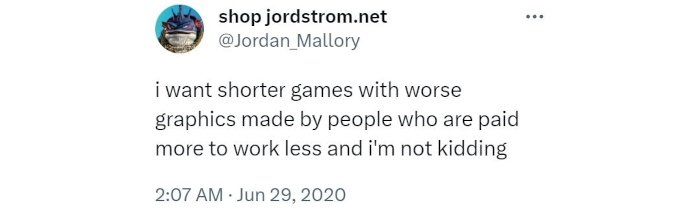
Or is it really just... yeah, there's a lot of people whose preferences are different from mine, and they are being given what they want by people who want to make it for them? And there is no problem being solved, and I'll just have to accept only occasionally getting games made for people like me who care about not having their time wasted?
You can see how it feels better to believe it's that first thing. But I dunno.